Description
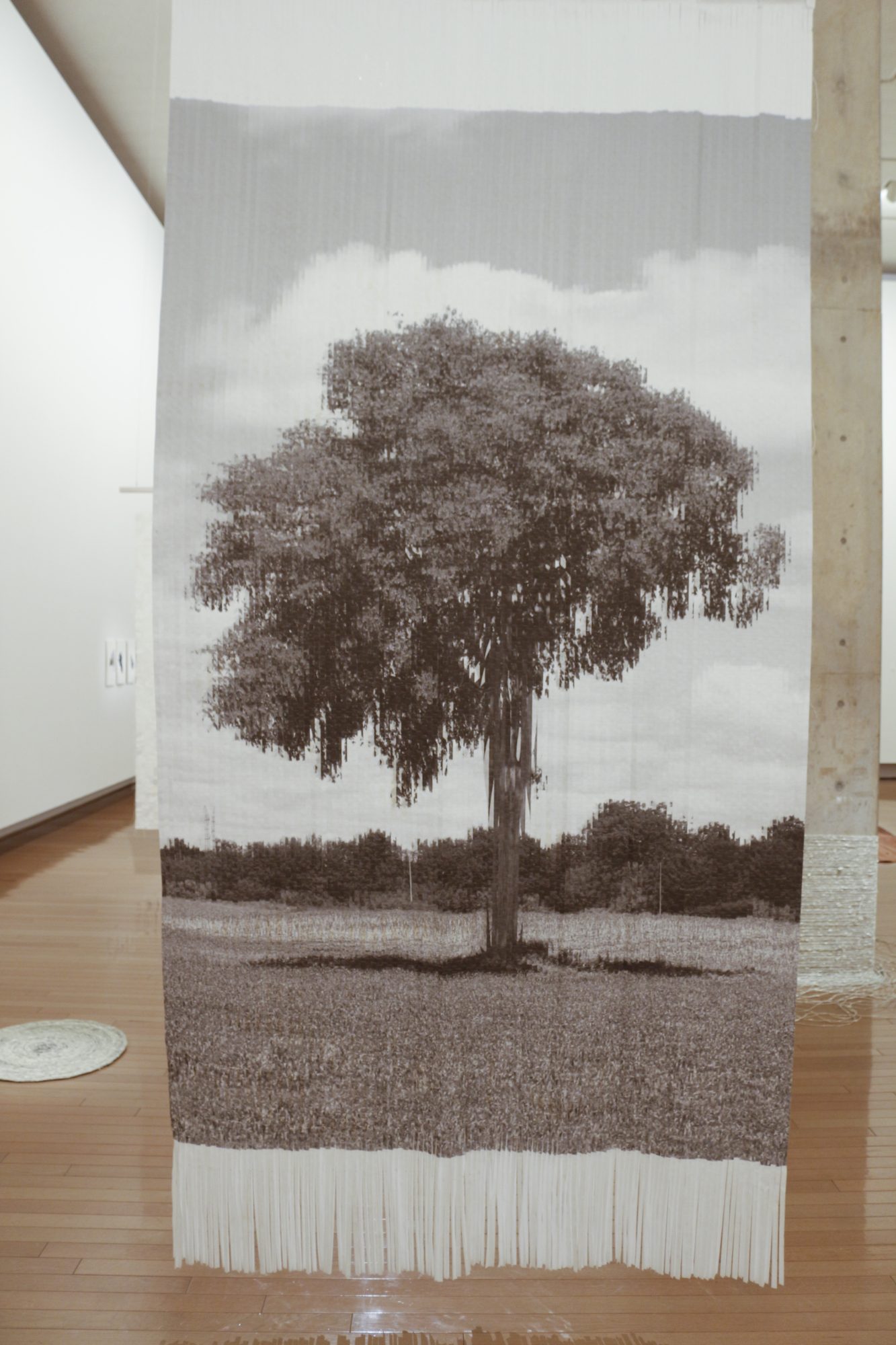
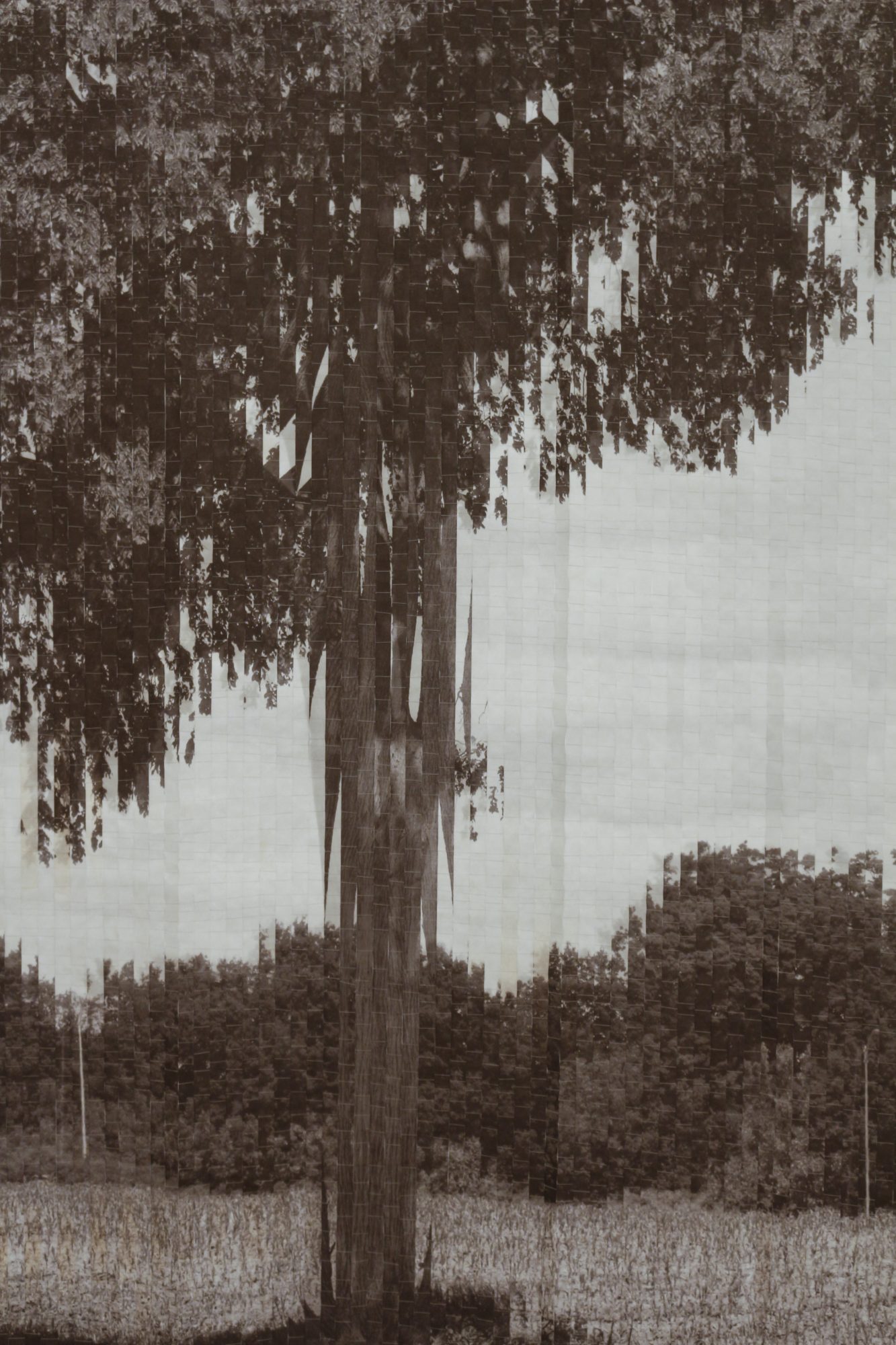
For 45˚37’58.20″ N, -74˚19’02.27″O (The Elm Tree) two copies of a photograph of a large elm tree in a field were printed on large sheets of Japanese washi paper using an inkjet printer. Each of the sheets was cut into vertical strips that were then folded in half. These were woven on a temporary loom. A linen thread was used as the horizontal warp. On one side of the weaving, the tree is a continuous image, while on the reverse side, the strips do not align as expected and the image is distorted. The weaving hangs in space so it can be viewed from both sides. The tree in the work is near La Chute, Québec and the title includes its geographic.
Two versions of this work exist, this one is slightly larger than 45˚37’58.20″ N, -74˚19’02.27″O (The Elm Tree 1) having been created for installation in a much larger venue Turn and Return / Faire et refaire , Prince Takamado Gallery, Canadian Embassy , Tokyo, Japan, 2015.
———————————————
Pour 45˚37′ 58.20″ N, -74˚ 19′ 02.27″O (L’orme), deux copies d’une photographie d’un grand orme dans un champ ont été imprimées sur de grandes feuilles de papier japonais washi à l’aide d’une imprimante à jet d’encre. Chacune des feuilles a été découpée en bandes verticales, qui ont ensuite été pliées en deux. Elles ont été tissées sur un métier à tisser temporaire. Un fil de lin a été utilisé comme chaîne horizontale. Sur l’endroit du tissage, l’arbre apparaît comme une image continue. L’envers, quant à lui, révèle une version brouillée, caractéristique de la technique de tissage utilisée par l’artiste. Le tissage est suspendu dans l’espace, de sorte qu’il peut être vu des deux côtés. L’arbre de l’œuvre se trouve près de la ville de Lachute, au Québec, et le titre indique ses coordonnées géographiques.
Deux versions de cette œuvre existent. Celle-ci est légèrement plus grande que
Statement
The elm was the inspiration for several works on paper and has a special place in my heart. My partner and I would often visit it, just to see how it was doing. This excellent example of the species, like most has a graceful, umbrella-shaped tree form. A solitary elm is often found in the middle of a field – the farmer having chosen to plant around it rather than to cut it down. Many of the species, American Elm have been attacked by disease, so when you find one that has managed to survive, it’s impressive. I see elms as a symbol of art and the artist in society.
————————————————-
L’orme a inspiré plusieurs œuvres sur papier et occupe une place particulière dans mon cœur. Mon conjoint et moi nous y rendions souvent, juste pour voir comment il se portait. Cet excellent exemple de l’espèce, comme la plupart des autres, est un arbre en forme gracieuse de parapluie. On trouve souvent un orme solitaire au milieu d’un champ, l’agriculteur ayant choisi de planter autour de l’orme plutôt que de le couper. De nombreuses espèces d’orme d’Amérique ont été attaquées par la maladie hollandaise des ormes, c’est pourquoi il est impressionnant d’en trouver une qui a réussi à survivre. Je considère l’orme comme un symbole de l’art et de l’artiste dans la société.